
During WW2, the US government and the publishing industry joined forces to provide US military personnel with books. Initially they had book drives, collecting donations from civilians. But hardback books were too big and heavy for soldiers to carry in the field and paperbacks weren’t really a thing back then. So they set about designing a book format that was small and light enough for soldiers to carry in their BDU pockets. Thus was born the Armed Services Edition (ASE). The books were oriented sideways with the binding on the short axis so they could print two books at a time and slice them in half horizontally. They came in two sizes: the smaller one fit army uniform breast pockets and the larger fit hip pockets.
The program was run by the Council on Books During Wartime (CBW), a nonprofit organization made up of booksellers, publishers, librarians and others in the book field. Their motto was “Books Are Weapons in the War of Ideas”. They were inspired by the Nazi book burnings of 1930s. Librarians were outraged by the mere idea of burning books.
The content of these books? Classics, history, contemporary fiction, humor, biographies, mysteries, westerns… they covered all the bases, even poetry. The Great Gatsby languished forgotten for 20 years. It didn’t become a hit until it was printed as an ASE. The CBW made a point of choosing books that were banned (and burned) by the nazis. The first book they printed as an ASE was The Education of Hyman Kaplan by Jewish writer Leo Rosten. They made the decision not to edit for moral or political content. If a book was deemed inappropriate or offensive in some way, they just didn’t include it at all rather cutting out the offending content. Zane Grey’s Riders of the Purple Sage was rejected for its portrayal of Mormons. But they did publish an ASE edition of Forever Amber, a book that was banned in 14 states for indecency. (Note: they had to condense Forever Amber because of its massive length. It couldn’t fit in the ASE format otherwise. But they did not cut the naughty bits.)
These books were an absolute godsend for soldiers and sailors on troop ships, the wounded in hospitals, and servicemen in inhospitable places like the Aleutian Islands and Guadalcanal. Many GIs wrote to the authors. The most popular ASE of all was A Tree Grows in Brooklyn by Betty Smith. Smith received about 1500 letters a year from servicemen and she replied to almost all of them, often sending an autographed photo by request. She was not a pinup girl, she was a writer pushing 50. To many GIs, she was like their mom.
Many of our fighting men were barely out of high school and their only experience reading was the books assigned in school. Reading for pleasure was a foreign concept until they were bored out their minds in places with no other form of entertainment. Before the war, the paperback industry mostly published cheap thrillers — pulpy stuff that was considered disposable. Serious books were always published in hardcover. After the war, the paperback industry took off. The Greatest Generation was also the most bookish generation.
After Germany surrendered, there was a severe shortage of books in Europe. The nazis burned a lot of books but they also bombed the publishing houses in London, which were all clustered together on the same street. There were no independent publishers left in Europe and there was a paper shortage following the war. Paper continued to be rationed in the UK until 1949. The CBW launched a new initiative to translate some of the ASEs into French, German, and Italian and distribute them in Europe. They called them Overseas Editions (OE). They wanted to translate them into Chinese and Japanese as well but they just didn’t have the budget for it. They distributed a total of 3.6 million OEs in Europe and North Africa of 72 titles (22 in English, 22 in French, 23 in German and 5 in Italian).
I don’t think anyone could argue about the success of the ASE program. It was the single biggest morale booster of anything the US government provided for the troops. It turned non-readers into readers. When US servicemen returned home after the war, millions of them took advantage of the GI Bill to go to college. They were reportedly excellent students. Civilian students called them DARs—Damned Average Raisers—for the effect they had on grading curves.
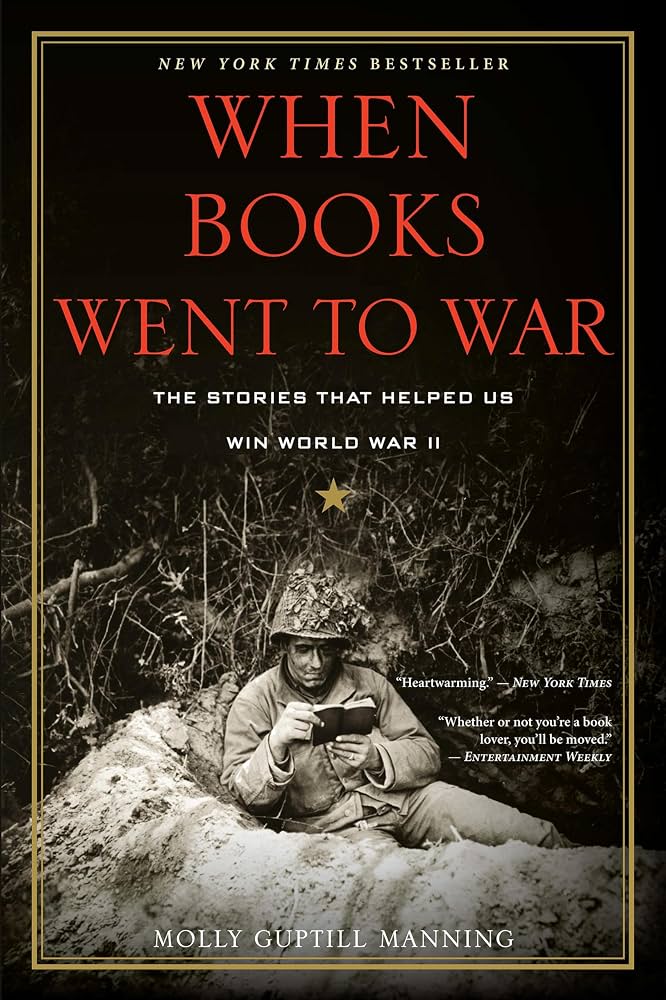
I love books about books and Manning’s book is a winner, a heartwarming account of a wartime program that I had never heard of before. People collect ASEs now—you can find them on eBay. The stationary company Field Notes printed an ASE mock-up of The Maltese Falcon last year. Yes, I bought it. I couldn’t resist. The dimensions are just slightly larger than their standard Field Notes notebooks, though considerably thicker of course. They tantalizingly tease potential future ASE editions inside the back cover, including authors such as Toni Morrison, George R.R. Martin and Neal Stephenson. I love that they included at least one trashy novel (Flowers in the Attic) just like the WW2 originals.

The Wikipedia article on the ASEs includes a complete list of all the books that were printed during WW2. In 2002, four new ASEs were produced for active duty military: Shakespeare’s Henry V, Sun Tzu’s The Art of War, Medal of Honor: Profiles of America’s Military Heroes from the Civil War to the Present by Allen Milaelian, and War Letters: Extraordinary Correspondence from American Wars by Andrew Carroll.
More info on this topic:
- Library of Congress research guide: https://guides.loc.gov/armed-services-editions-collection
- Article on collecting ASEs: https://www.militarytrader.com/militaria-collecting-101/collecting-armed-service-editions
- University of Virginia exhibit: https://explore.lib.virginia.edu/exhibits/show/booksgotowar/walk
- Atlas Obscura feature: https://www.atlasobscura.com/articles/armed-services-editions-pocket-paperback-books
Leave a Reply